Why the Next AI Update Won't Fix Your Business
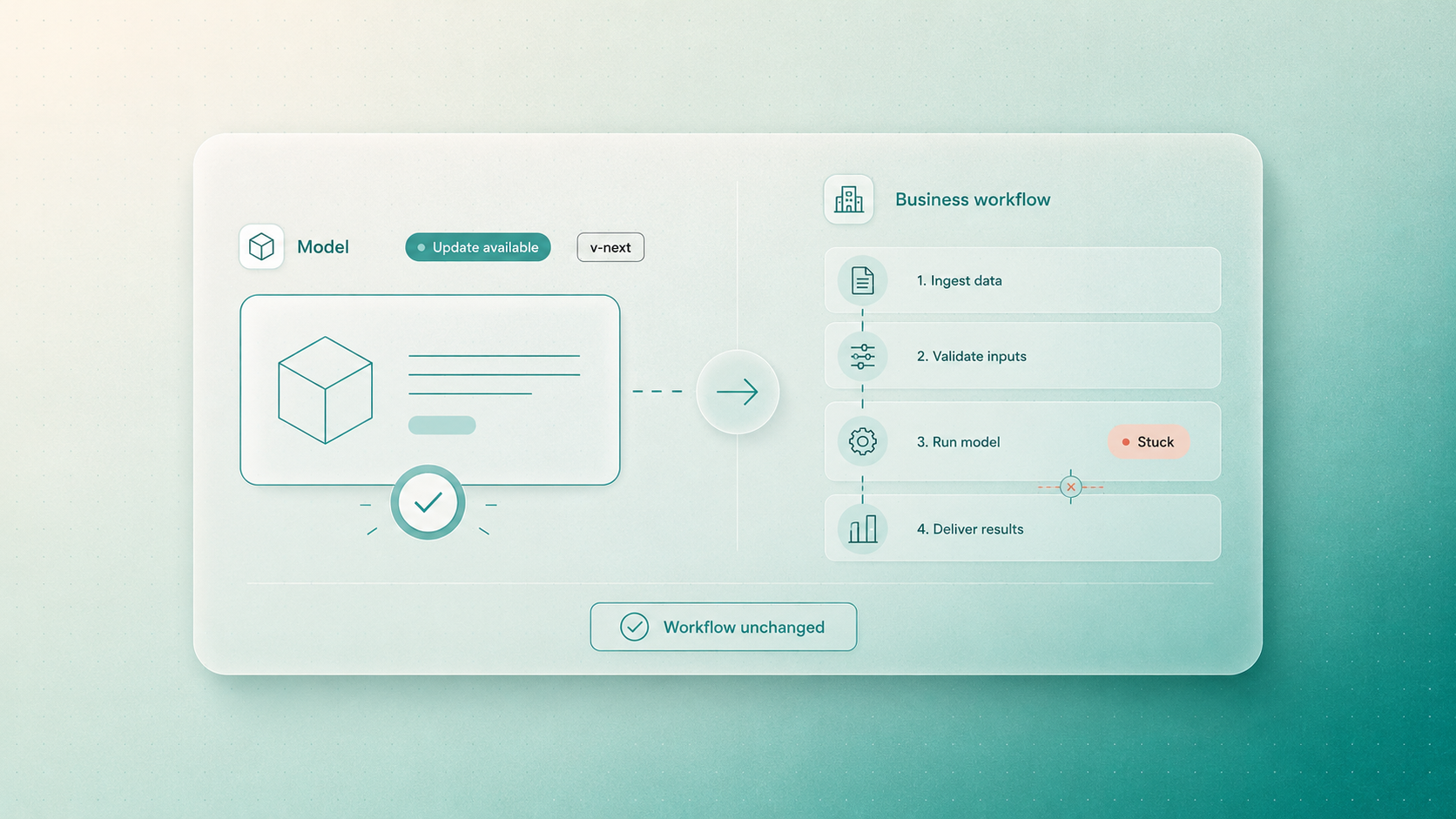
If you are waiting for the next AI model release to finally make AI useful inside your business, you may be waiting for the wrong thing.
Every few months, a new model arrives with better benchmarks, faster responses, larger context windows, or more polished demos. Those improvements matter. But they rarely fix the operational problems that stop AI from creating value in a real company.
The hard part is no longer getting access to a powerful AI model. The hard part is turning that model into a system that understands your workflow, handles your data correctly, follows your approval rules, and fits into the way your team already works.
That is why the next AI update will not fix your business on its own. Your business does not need a smarter chat box as much as it needs a better operating system around the AI.
Better Models Do Not Automatically Create Better Workflows
AI models keep improving, but business results do not automatically improve at the same speed.
The reason is simple: a model is only one part of the system. It can summarize, classify, draft, search, reason, and generate. But it does not automatically know which lead is worth prioritizing, which client exception needs human review, which invoice field is unreliable, or which report your leadership team trusts every Monday morning.
In most businesses, AI fails in the gap between model capability and workflow reality.
A stronger model might make a better first draft. It might answer a prompt more smoothly. It might reduce some mistakes. But if the team still has to copy information between five tools, rewrite the output manually, check every answer from scratch, and decide where the result should go next, the business has not really changed.
The work still depends on manual routing, manual judgment, and manual cleanup.
That is not a model problem. It is a system problem.
The Real Missing Piece Is the AI Harness
Think of the AI model as an engine. It can be powerful, expensive, and impressive. But an engine sitting on the floor does not move the business forward.
To make it useful, you need the rest of the vehicle: steering, brakes, controls, fuel lines, safety systems, a dashboard, and a driver who knows where they are going.
In business AI, that surrounding system is the harness.
An AI harness is the software, workflow design, and governance layer around the model. It controls what information the AI receives, where the output goes, when a human needs to approve something, and how exceptions are handled.
Without a harness, AI is just another tool your team has to manage. With a harness, AI can become part of the workflow.
A useful harness might:
- Pull the right customer data from your CRM
- Clean and structure messy inputs before the AI sees them
- Apply business rules before generating an output
- Route low-risk tasks automatically
- Flag risky or uncertain cases for human review
- Push the final result back into the right system
- Track usage, errors, and time saved over time
That is where practical AI value starts to appear. Not because the model is magical, but because the business has designed the conditions for the model to be useful.
Context Is Not the Same as Dumping More Data Into a Prompt
Many teams try to solve AI reliability by giving the model more information.
They paste long client histories, full policy documents, complete operating manuals, messy spreadsheets, and entire email threads into a prompt. The hope is that more context will lead to better answers.
Sometimes it helps. Often it creates a different problem.
Too much context can confuse the system, slow the workflow, and bury the specific instruction the AI actually needs. A good AI system does not throw the whole atlas at the driver. It gives the next useful direction at the right moment.
For a proposal workflow, the AI may need the prospect's industry, the services discussed, pricing rules, and the last approved proposal format. It does not need every email the prospect has ever sent.
For a reporting workflow, it may need this week's performance data, variance rules, and the leadership team's preferred summary structure. It does not need the entire archive of past reports.
For a support workflow, it may need the customer's plan, ticket history, severity rules, and escalation criteria. It does not need every internal comment ever written about the account.
Better context design means giving AI the right information, at the right time, in the right structure.
What AI Can Reliably Improve Right Now
AI does not need to solve every abstract business problem to be worth using.
In fact, the best opportunities are often specific, repeated, and close to existing operational drag. These are the workflows where your team already knows the pain, the input is relatively clear, and the output can be reviewed.
AI can be useful today for:
- Turning raw lead intake into structured qualification notes
- Drafting proposal sections from approved inputs
- Summarizing client calls into next steps and risks
- Cleaning and classifying operational data
- Preparing weekly reports from known data sources
- Routing support requests based on urgency and category
- Creating first drafts of content from a defined brief
- Extracting useful fields from forms, emails, or documents
These are not science-fiction use cases. They are operational use cases. That is exactly why they work.
They remove repeated effort from the business without asking AI to make the highest-risk decision alone.
The Question Is Not "Which Model?" It Is "Which Workflow?"
Model choice matters, but it should not be the first strategic question.
Before choosing a model, ask:
- Which workflow is costing the most time or creating the most rework?
- Where does the team already have a clear process, even if it is manual?
- What inputs are needed for a useful output?
- Which decisions can be automated, and which need human review?
- What would the system need to do before the team trusts it?
- How will we know whether it is saving time, improving quality, or reducing risk?
This moves the conversation from AI excitement to operational clarity.
If the workflow is vague, the AI project will be vague. If the workflow is specific, the first version can be specific too.
That is where momentum comes from.
Do Not Wait for the Tech Giants to Solve Your Bottleneck
The largest AI companies will keep improving models. That is good news. But they are not going to redesign your sales handoff, clean your internal reporting process, map your approval rules, or decide which customer exception needs escalation.
Those are business-specific problems.
They require someone to understand your workflow, your team, your systems, your data, and your risk tolerance. They require implementation, not just access.
At WhatanAidea, this is where we focus. We do not start by asking which shiny model release you want to chase. We start by asking where your business is stuck.
Then we build the harness around the AI so it can actually help.
That may mean a custom workflow automation, an internal agent, a reporting pipeline, a proposal assistant, a lead intake system, or a practical software layer that connects the tools your team already uses.
The model is important. But the model is not the whole solution.
Build the System Around the AI
The next AI update may be faster. It may be more capable. It may make impressive demos easier.
But your business will still need context, workflow design, human review, measurement, and adoption.
If AI has not worked for your business yet, the answer is probably not to wait for the next release. The answer is to build a better system around the capability that already exists.
Start with the bottleneck. Design the workflow. Give the model the right context. Add guardrails. Put humans in the right review points. Measure whether the system is actually changing the work.
That is how AI becomes useful.
If your team is tired of testing AI tools that never become part of daily operations, WhatanAidea can help you identify the workflow worth fixing first and build the practical AI system around it.
Supporting Links
- McKinsey, The State of AI: Global Survey 2025: https://www.mckinsey.com/capabilities/quantumblack/our-insights/the-state-of-ai
- McKinsey, The State of AI: How Organizations Are Rewiring to Capture Value: https://www.mckinsey.com/capabilities/quantumblack/our-insights/the-state-of-ai-how-organizations-are-rewiring-to-capture-value
- Stanford HAI, AI Index Report 2026, Economy chapter: https://hai.stanford.edu/assets/files/ai_index_report_2026_chapter_4_economy.pdf
- NIST, Artificial Intelligence Risk Management Framework 1.0: https://www.nist.gov/publications/artificial-intelligence-risk-management-framework-ai-rmf-10
Written by

WhatanAIdea is an outcome-first AI consultancy. We go deep into your business first, then show where AI fits, where it doesn’t, and what is worth doing first.