The Time Thief Blueprint: How to Find the Workflow Quietly Draining Your Business
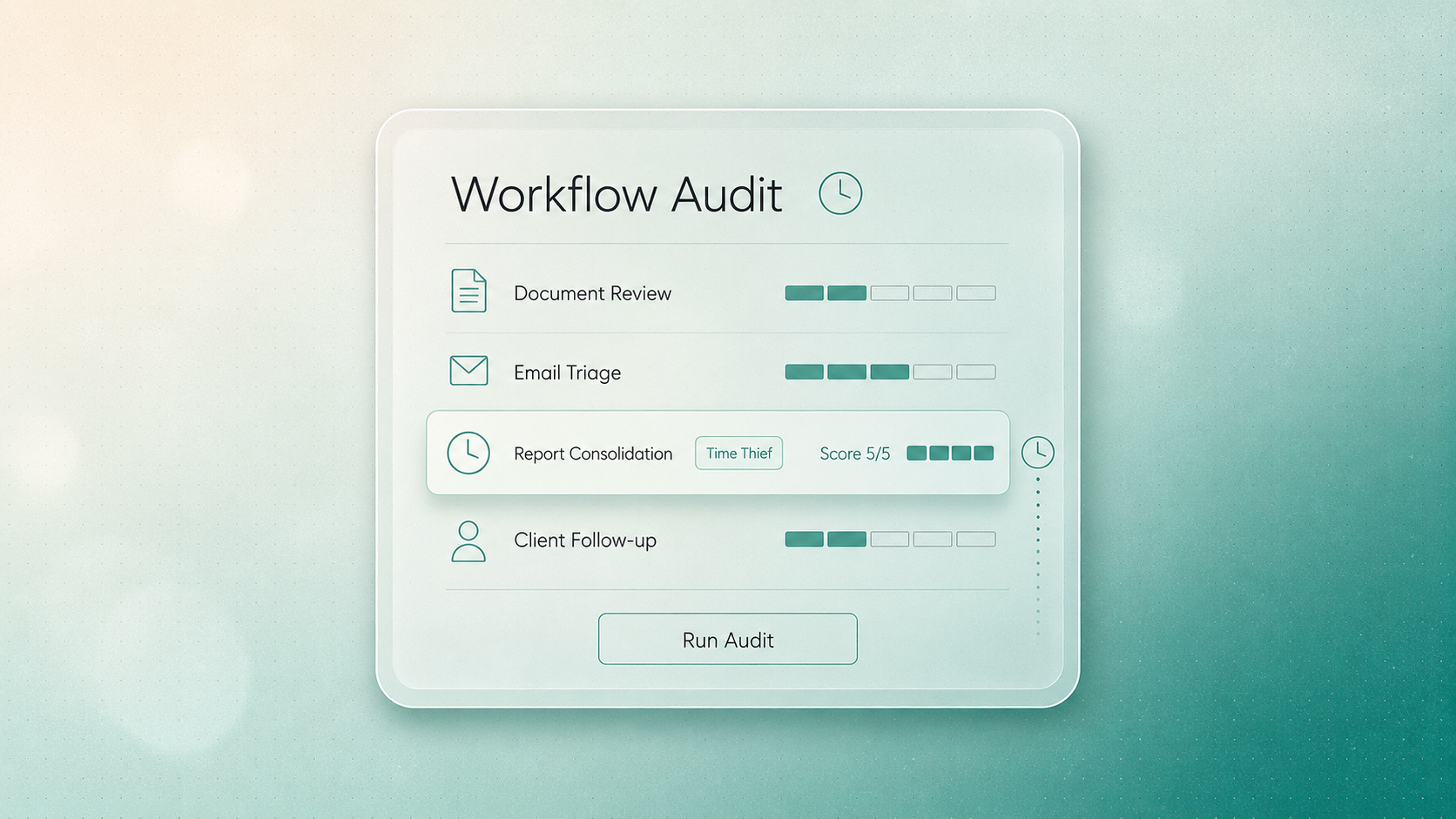
Most business owners know when the team is busy. Far fewer know exactly where the time is going.
That is the uncomfortable part.
You can have talented people, decent tools, steady demand, and a full calendar, yet still feel like the business is moving slower than it should. Growth projects keep slipping. Follow-ups happen late. Reports take too long. The team feels stretched, but nobody can point to one dramatic operational failure.
That is usually how a Time Thief works.
A Time Thief is not one huge broken process. It is a repeated, rules-driven task that quietly steals attention from people who should be doing higher-value work. It hides in normal routines: formatting data, chasing missing details, preparing the same updates, copying information between systems, or rebuilding work that should already be reusable.
The good news is that these tasks are often the best first candidates for automation, because they are frequent, measurable, and usually painful enough that the team already wants them gone.
Start with irritation, not technology
The easiest mistake is to begin by asking, "What can we automate?"
That question sounds practical, but it often sends the team into tool mode too early.
Start with a better question:
What task keeps coming back even though nobody believes it is the best use of their time?
That question gets you closer to the real bottleneck.
Ask it in a team meeting and listen for the small complaints. Not the grand strategy problems. The eye-roll tasks. The work people describe with phrases like:
- "I have to do this every Monday."
- "I always need to clean it before anyone can use it."
- "The information is never in one place."
- "It only takes ten minutes, but it happens constantly."
- "If I do not chase it, it does not move."
Those sentences are clues.
The four signs of a real Time Thief
Not every annoying task should be automated. Some work is messy because it requires judgment, negotiation, taste, or emotional intelligence.
A real Time Thief usually has four traits.
1. It happens often
Daily is obvious. Weekly is enough. Monthly can matter if the process is painful, high-stakes, or involves senior people.
Frequency matters because automation pays back through repetition. A task that happens once a quarter may be frustrating, but it is rarely the best first target.
2. It follows rules
If a capable person can explain the process step by step, there is probably structure inside it.
For example:
"When a lead comes in, check the company size, look at the service requested, search whether we have spoken to them before, add the notes to the CRM, then send one of three follow-up messages."
That is not just admin. That is a workflow.
3. It interrupts better work
The real cost is not only the time spent on the task. It is what the task displaces.
An account manager preparing the same client update again is not thinking about account risk. A founder chasing missing inputs is not selling, hiring, or steering the business. An operations lead cleaning a spreadsheet is not improving the system that produced the messy data.
The thief steals attention before it steals hours.
4. It creates downstream drag
Some tasks look small until you notice how many other things wait for them.
A late report delays a decision. A missing intake form delays onboarding. A messy content handoff delays publishing. A slow follow-up delays revenue.
The best automation candidate is not always the task that takes the longest. It is the task that creates the most drag around it.
A quick field exercise
You do not need a transformation workshop to find your first Time Thief.
Pick one team or workflow and run this simple audit.
Step 1: List the repeat offenders
Ask each person to name three tasks they repeat every week that feel lower-value than the rest of their job.
Do not debate solutions yet. Just collect the list.
Step 2: Score each task
Give each task a score from 1 to 5 for:
- Frequency: how often it happens.
- Rule clarity: how easy it is to describe step by step.
- Seniority waste: how expensive or skilled the person doing it is.
- Downstream impact: how much other work depends on it.
- Review safety: how easily a human can check the output before it matters.
The task with the highest score is not automatically the answer, but it is where the conversation should begin.
Step 3: Find the hidden handoffs
For the top two tasks, ask:
- Where does the information come from?
- Where does it need to go?
- Who checks it?
- What happens when something is missing?
- What does the team do manually because systems do not connect?
This is usually where the real automation opportunity appears.
Step 4: Choose one battle
Do not try to automate the whole business.
Choose one workflow that is repetitive, painful, visible, and safe to improve. The first win should build confidence. It should make the team say, "Yes, please remove more of that."
What Time Thieves look like in the real world
In a sales workflow, the Time Thief might be lead preparation. Every new enquiry needs research, qualification notes, CRM updates, and a first follow-up. The automation opportunity is not "replace sales." It is preparing the context so a human can respond faster and better.
In a delivery workflow, the thief might be project kickoff. The team keeps asking for the same files, brand assets, access details, and context after the sale closes. The fix might be a structured intake flow that gathers missing information, assigns owners, and prepares the kickoff brief.
In a reporting workflow, the thief might be weekly visibility. Someone exports data, cleans the sheet, checks the numbers, and rewrites the same summary. The fix might be an exception-based report that pulls the right inputs and highlights what actually needs attention.
In a content workflow, the thief might be adaptation. One idea gets manually turned into email copy, social posts, ad variants, captions, and internal notes. The fix is not generic content generation. It is a repeatable system for adapting approved thinking into the right formats.
Different businesses have different thieves. The pattern is the same: repeated work, clear rules, manual handoffs, and skilled people pulled away from higher-value decisions.
What not to automate first
Avoid starting with work that is politically sensitive, poorly understood, or heavily dependent on human judgment.
Do not begin with the process everyone argues about but nobody can explain. Do not begin with a customer-facing decision that could damage trust if it goes wrong. Do not begin with a workflow where the data is so messy that nobody knows what "correct" means.
Those may become automation opportunities later. First, they need diagnosis.
Your first AI or automation project should be boring enough to be safe and valuable enough to matter.
How WhatanAidea helps
At WhatanAidea, we start by helping you find the right first bottleneck.
Sometimes the answer is an AI workflow. Sometimes it is a simpler automation. Sometimes it is cleaning up the process before adding technology. The point is not to automate for the sake of it. The point is to remove the work that is quietly slowing the business down.
If you already know your biggest Time Thief, we can help map what a practical fix would look like.
If you only know that the team is busy and the business still feels slower than it should, we can help you find the thief first.
Book a 30-minute Time Thief audit with WhatanAidea. We will help you identify one repeatable workflow worth improving, estimate where the drag is coming from, and decide whether AI belongs in the solution.
Supporting Links
- Harvard Business Review, Collaborative Overload: https://hbr.org/2016/01/collaborative-overload
- Microsoft Work Trend Index, Will AI Fix Work?: https://www.microsoft.com/en-us/worklab/work-trend-index/will-ai-fix-work
- Gallup, Employee Burnout: The Biggest Myth: https://www.gallup.com/workplace/288539/employee-burnout-biggest-myth.aspx
- ScienceDirect, Process Science in Action: A Literature Review on Process Mining in Business Management: https://www.sciencedirect.com/science/article/pii/S0040162521004534
- TechTarget, Top enterprise process mining challenges and solutions: https://www.techtarget.com/searcherp/tip/Top-enterprise-process-mining-challenges-and-solutions
Written by

WhatanAIdea is an outcome-first AI consultancy. We go deep into your business first, then show where AI fits, where it doesn’t, and what is worth doing first.