AI Does Not Need to Replace Your Team to Transform Your Business
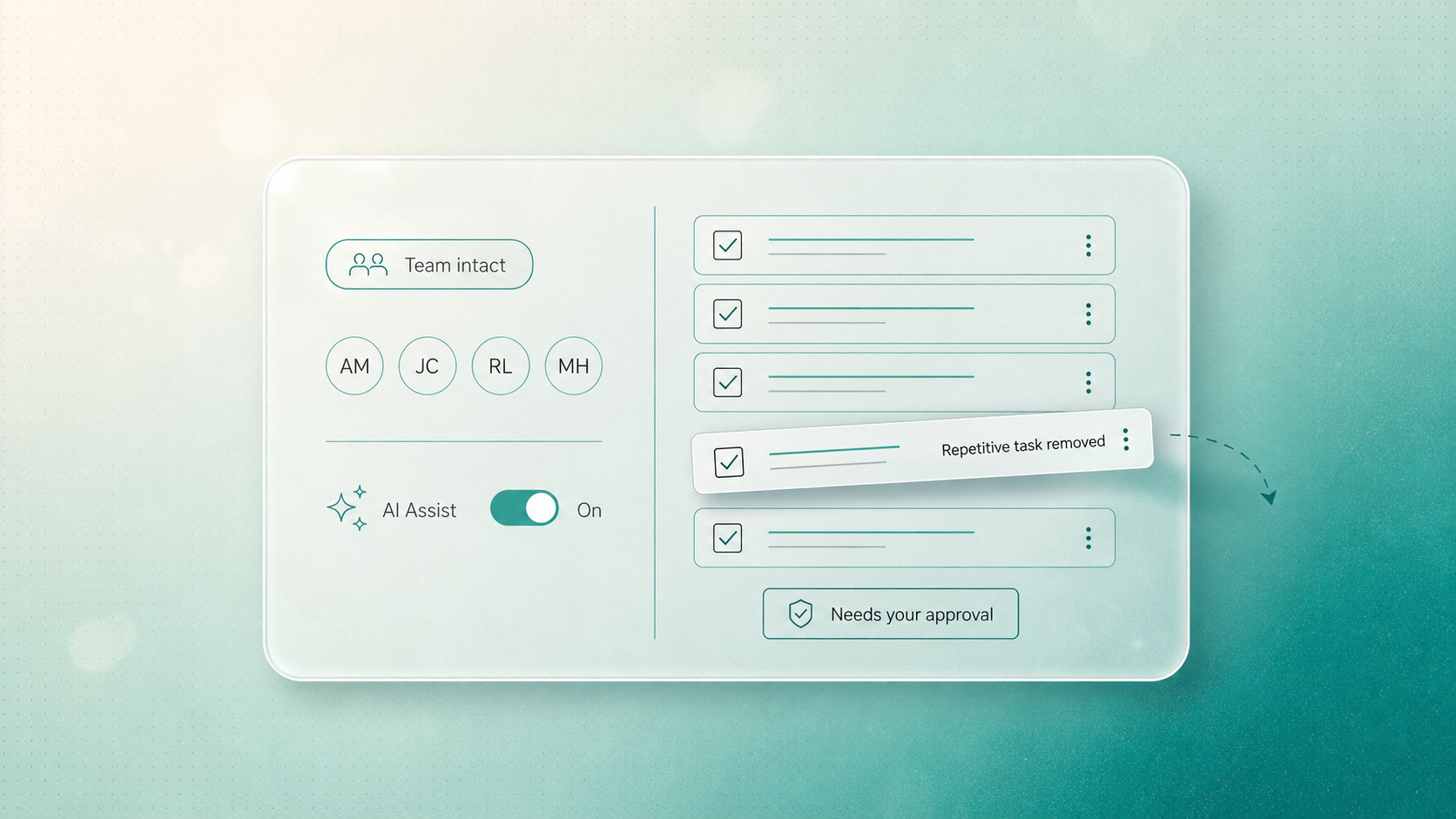
The fastest way to make a good team suspicious of AI is to introduce it like a threat.
Founders feel this more than most people admit. You have spent years hiring people you trust, protecting the culture, and building a business that does not collapse the moment a senior person takes a week off. Then the AI conversation arrives, and too much of it sounds cold: fewer people, lower costs, more output, less humanity.
If you care about your team, that framing creates a real hesitation. Not because you are anti-technology. Because you know that trust is operational infrastructure too.
At WhatanAidea, we think the better question is not, "Who can AI replace?"
The better question is, "What work should your best people no longer have to carry?"
That distinction changes everything.
The fear is not irrational
Most leaders are not afraid of automation itself. They are afraid of what it might do to the room.
Will the team think this is the beginning of a quiet replacement plan? Will people hide the messy parts of their work because they are worried those tasks will be automated? Will managers start measuring people by how many manual tasks disappear instead of how much better the business runs?
Those are not soft concerns. They affect adoption.
If your team does not trust the intent behind an AI project, they will not give you the honest process detail you need to make it work. They will nod in meetings, keep using old workarounds, and wait for the experiment to fade.
That is why human-centered AI implementation starts with language.
Do not tell your team, "We are automating roles."
Tell them the truth: "We are removing the work that keeps pulling you away from the job we actually hired you to do."
Look at the work people complain about
Every business has tasks that everyone knows are necessary, but nobody believes are the best use of a skilled person's time.
The account manager rebuilding the same client update from three different systems.
The strategist who should be thinking about a campaign, but is cleaning notes, chasing assets, and formatting the deck.
The operations lead who knows how the process should run, but spends half the day checking whether people followed it.
The designer who is hired for taste and judgment, but keeps losing time to resizing, renaming, exporting, and uploading files.
The founder who wants to focus on growth, but keeps getting dragged back into approvals, follow-ups, and internal status checks.
This is where AI earns its place.
Not in replacing the person. In removing the drag around the person.
The best first AI project is usually a relief
A useful first AI workflow should feel almost boring.
It should not begin with a dramatic transformation announcement. It should begin with a sentence your team already believes:
"This task is wasting too much time."
That might be preparing weekly client reports, sorting inbound leads, summarizing meeting notes, collecting kickoff information, or drafting first-pass responses for human review.
The point is not to prove that AI is impressive. The point is to remove a real source of friction without making the team feel watched, judged, or replaced.
When that first workflow is chosen well, the reaction is not fear.
It is relief.
"I do not have to do that manually anymore?"
That is the adoption moment you want.
Good AI implementation changes the shape of the job
The wrong version of automation squeezes more output from the same tired system. The right version changes the shape of the workday.
An account manager spends less time assembling updates and more time spotting client risk before it becomes a problem.
A strategist spends less time cleaning raw inputs and more time making sharper decisions.
An operations lead spends less time chasing compliance with the process and more time improving the process itself.
A designer spends less time preparing assets and more time applying taste.
A founder spends less time being the emergency router for every loose end and more time building the next stage of the company.
This is the cultural promise of well-designed AI: not that humans disappear, but that the human part of the work becomes more visible.
Judgment. Taste. Empathy. Context. Accountability. Commercial instinct. The ability to notice that something is technically correct but still wrong for the client.
Those are not things you want to automate away. Those are the things you want to protect.
The leadership mistake to avoid
The mistake is treating AI adoption like a technology rollout when it is also a trust exercise.
If you start with the tool, the team hears, "Here is another thing to learn."
If you start with efficiency, the team may hear, "Here is why we need fewer people."
If you start with the work, the conversation changes.
Ask your team:
- What task do you repeat every week that should not need this much attention?
- Where do you copy information from one place to another?
- What work do you delay because admin gets in the way?
- Which part of the process creates the most avoidable frustration?
- What would make your week noticeably lighter without lowering quality?
Those questions surface better AI opportunities than most software demos.
They also make the team part of the design, not the target of the design.
How WhatanAidea approaches this
We do not believe every business needs to rush into a large AI transformation project.
Most businesses need a calmer first step: find the workflow that is painful, repetitive, measurable, and safe to improve.
Then build around that.
Sometimes that means a small automation. Sometimes it means an AI-assisted review process. Sometimes it means an agent that prepares work in the background and stops before a human approval point. Sometimes it means simplifying the process before adding AI at all.
The technology matters. But the order matters more.
Listen first. Diagnose the work. Design the workflow. Then decide where AI belongs.
The real win
AI does not need to replace your team to transform your business.
In many companies, the bigger opportunity is helping the team you already have do the work they are actually good at. Less chasing. Less formatting. Less repetitive preparation. Less time spent holding together systems that should have been designed better.
That is not anti-human. It is the most human reason to use the technology.
If you want to start without creating anxiety, start with the workflow your team will thank you for fixing.
Book a 30-minute workflow audit with WhatanAidea. We will help you identify one high-friction task, decide whether AI belongs in the answer, and map a first step your team can trust.
Supporting Links
- McKinsey, The State of AI: How Organizations Are Rewiring to Capture Value: https://www.mckinsey.com/capabilities/quantumblack/our-insights/the-state-of-ai-how-organizations-are-rewiring-to-capture-value
- McKinsey, The State of AI: Global Survey 2025: https://www.mckinsey.com/capabilities/quantumblack/our-insights/the-state-of-ai
- NIST, Artificial Intelligence Risk Management Framework 1.0: https://www.nist.gov/publications/artificial-intelligence-risk-management-framework-ai-rmf-10
- Boston University Digital Business Institute, Why Gen AI Feels So Threatening to Workers: https://www.bu.edu/dbi/2026/02/09/why-gen-ai-feels-so-threatening-to-workers/
Written by

WhatanAIdea is an outcome-first AI consultancy. We go deep into your business first, then show where AI fits, where it doesn’t, and what is worth doing first.